Battle of Austerlitz
1805 · Europe Medium
Russo-Austrian Army — La Grande Armee · 11 turns · 78 units
Briefing
« Combien de temps vous faut-il pour porter vos divisions sur les hauteurs de Pratzen ? » « Moins de vingt minutes, Sire. » « En ce cas, attendons encore un quart d'heure. »
"How long do you need to bring your divisions up onto the heights of Pratzen?" "Less than twenty minutes, Sire." "In that case, let us wait another quarter of an hour." -- Napoleon and Marshal Soult before dawn (from Ségur's memoirs; attributed)
He did not leave the heights empty because he was losing. He left them empty to be seen doing so.
2 December 1805, the hill country of Moravia. The day was the first anniversary of Napoleon's coronation. After taking Vienna, the French army's supply lines were stretched to the limit, and the Emperor played the part of "an army that is tired, uncertain and eager to withdraw". Two days before, he had pulled his troops off the Pratzen heights in the centre and left only a single division along the Goldbach on his right. The young staff officers of the allies saw this and concluded that they could win by swinging round from the south and cutting the road to Vienna. At one o'clock the previous night, the Austrian staff officer Weyrother spent five hours reading out the orders. The Russian generals listened to the order of the columns, written in German, while waiting for the translation. Kutuzov is said to have fallen asleep partway through. When day broke, the valleys lay under a milk-white fog; only the heights were clear.
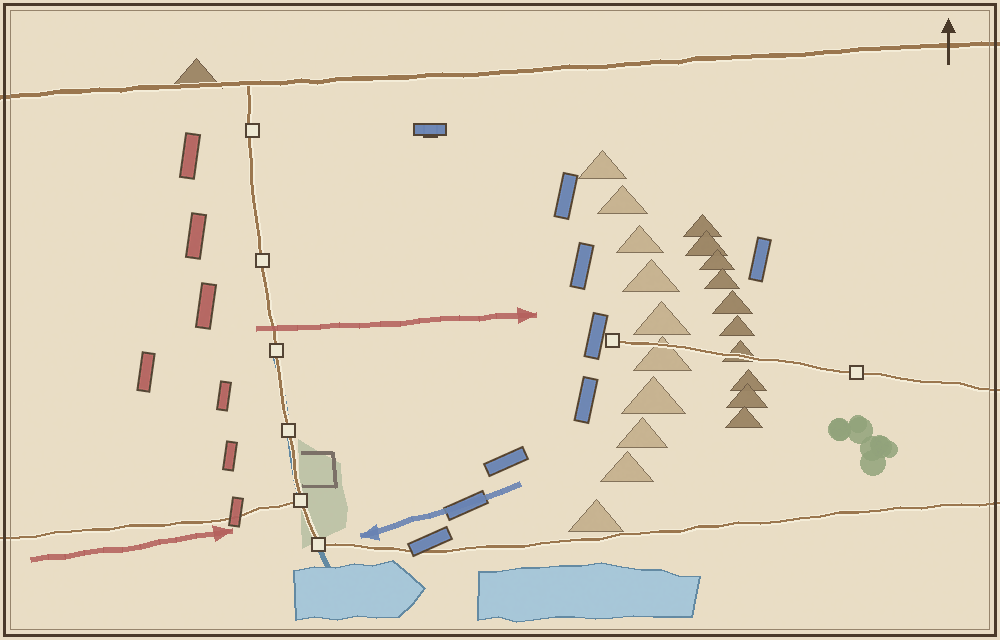
[The Pratzen heights] In the centre of the board, around the village marked Pratzen, the northern shoulder is Stare Vinohrady (the old vineyard) and the southern shoulder is Pratzeberg. These three account for half the victory points on the board (40, 24 and 24). At the start all three belong to the allies. The allied plan is to come down from here and march south, and every unit that comes down leaves the points themselves thinner.
[How the allies win] The board opens at a margin of plus 70, because the allies hold the three points on the heights, Krzenowitz (20) in the rear, and Blasowitz (14) on the right. The victory line is plus 78. In other words, the allies win only if they give up none of the heights and also come out ahead in the exchange of losses. Put the other way, losing the village of Pratzen alone moves the margin by 80. Losing all three moves it by 176. Whatever is taken in the south does not move this calculation by a single point, because the southern flags are not victory points.
[How France wins] France need only keep the margin below the victory line until nightfall. What that requires is the heights, not the villages in the south. France has 37 units, four fewer than the allies. It can move 14 at a time (15 from T3, when Davout's corps joins).
[The four southern flags] In the south of the board, along the French right, stand flags at Kobelnitz, Sokolnitz Cast, Sokolnitz and Telnitz. They carry no victory points at all. While the allies hold them, the allies can simply move more counters at a time (+1, +2, +2, +2; with all four, 13 becomes 20). They are defended only by Legrand's single division, strung thinly along the west bank of the stream: Levasseur, the Corsican chasseurs, the chasseurs of the Po, Merle, and the 26th Light. Take them and you gain moves. Only moves, not points. Meanwhile, troops drain away from the heights, which are the points themselves. The error the allies made in history rises up on the board as a rational temptation. The road back to the heights after taking all four is the hardest decision on this board. Note that the brook (the Goldbach) is drawn on the board only south of Sokolnitz castle, where it runs between wet meadows; an attacker crossing from the east is at a disadvantage. Upstream it is only a ditch, and Soult's divisions crossed it without difficulty.
[Aujezd] At the southern edge, at the mouth of the causeway between the two ponds, stands a flag that works the other way. While France holds Aujezd, the allied activation limit falls from 13 to 10. Nothing happens to France. The more troops the allies send south, the heavier this one hex weighs, because it is their exit that is being squeezed. At the start it belongs to the allies.
[The Guard] The three French Guard units (Bessières's Guard cavalry, Rapp's chasseurs à cheval, and the foot grenadiers) are drawn with a light blue border. The moment any of the three first attacks or is attacked, one extra round of movement and combat comes round after that turn. Only the three Guard units can move, and the activation limit is not counted. The obligation to fight still applies in the extra round, but it binds only the Guard and the enemies adjacent to the Guard. It can be used once per game, and only France has it. There is no way to prevent it. All you can do is shift its timing: strike the Guard first, and you force it to be spent at a moment you prepared for, not at the opportunity it would have chosen. Historically, at about one o'clock, Grand Duke Constantine's Russian Guard came out to retake the heights, and the Guards of both armies met head-on.
[Davout's corps] In the south-west of the board, III Corps enters by the road from Raigern on T2 (eight o'clock): Davout, Friant and Heudelet. Bourcier's dragoons come on T3. They had marched 110 kilometres in forty-eight hours: seven thousand men who caught up from Vienna. Whether the first counter to be struck at Telnitz (the 26th Light) can hold becomes a race against this arrival.
[The frozen ponds] The two ponds in the south-east (Satschan and Menitz) are frozen. On the board they are pale blue: passable, but they consume the whole movement allowance. So for an army that has gone south, the only fast road home is the single causeway.
[Commanders] Allies (Russian = green counters / Austrian = steel-coloured counters): Commander-in-chief Kutuzov. Tsar Alexander I was at headquarters and in practice held the power of decision. The Austrian Emperor Francis II was also on the field but did not command, so he is not a counter. Weyrother, who wrote the plan, is absent for the same reason. The 4th Column in the centre: Kolowrat and Miloradovich, with the brigades of Rottermund (who held the vineyard), Jurczik (who fell on the heights) and Berg. The left wing: Buxhoeveden, led by Kienmayer's advance guard of Carneville, Stutterheim and Nostitz. 1st Column Dokhturov, 2nd Column Langeron, 3rd Column Przybyszewski ("Przybysz" is the spelling that fits the counter). Langeron's brigade commander Kamensky, on his way south, saw French troops climbing the heights and turned back on his own authority. To the north, Prince Liechtenstein's 5th Column, Hohenlohe's cuirassiers, Uvarov, and in the advance guard Bagration, Dolgorukov and Engelhardt. The Guard: Grand Duke Constantine, the Chevalier Guard, and the Preobrazhensky, Semyonovsky and Izmailovsky regiments. Prince Repnin-Volkonsky, who led a squadron of the Chevalier Guard, was captured by Rapp that day and brought before the Emperor.
France (blue counters): Napoleon I. From the centre southward, Soult's IV Corps: Vandamme, Saint-Hilaire, the brigade of Thiébault (who led the 10th Light up first), the 57th of the Line, "the Terrible", the 24th Light, and Legrand on the southern wing. To the north, Lannes's V Corps (Suchet, Caffarelli) and Claparède's 17th Light, who dug the redoubt on the Santon. The eighteen guns of the redoubt are said to have been emplaced by Senarmont. The cavalry reserve under Murat: Nansouty, d'Hautpoul, Walther and Kellermann. In the centre rear, Bernadotte's I Corps (Rivaud, Drouet). The reserve grenadier division properly belonged to Oudinot, but that day he was recovering from a wound received at Hollabrunn, and Duroc stood in for him. From the south-west, Davout's III Corps.
[What to decide in these ten hours] Allies: how far do you go for the four southern flags? Take all four and you gain seven moves, but the army that uses those seven is not on the heights. How many units must you leave on the heights to hold until Soult climbs up? Who guards the mouth at Aujezd? France: how long can you hold the right wing with a single division? Where and when do you commit the Guard's stroke? Early, and it will surely land, but on outposts. Late, and it can split a thinned centre, but by then your men in the south may be gone.
[Outcome] At nine o'clock, just before the fog lifted, Soult's two divisions climbed out of the valley. Miloradovich's remaining five battalions and Rottermund's Austrian brigade resisted on the heights, but they were pushed from the front, turned from the flank, and fell back. Jurczik fell. Kamensky, who had been heading south, turned back and fought on the slope; Langeron went off to look for help and did not return. At one o'clock Grand Duke Constantine's Russian Guard came out to retake the heights. The Chevalier Guard broke a French battalion, and Bessières's Guard cavalry was thrown in against its front. Rapp returned to the Emperor with standards and prisoners, and is said to have reported, his face covered in blood, "This is the Chevalier Guard." The moment the heights were lost, the three southern columns found the enemy astride their line of retreat. Buxhoeveden's army was forced onto the causeway and the frozen ponds, and the gun carriages broke the ice. Napoleon wrote in his bulletin that twenty thousand drowned, but when the ponds were later drained, it is said that only a few bodies and about 150 horses were recovered. The allies lost 27,000 men and left 180 guns behind. French losses were fewer than 9,000. On 4 December, Francis II met Napoleon beside a campfire and asked for an armistice, and on the 26th peace was made at Pressburg. The Third Coalition was gone. In London, Pitt the Younger read the news, pointed to the map of Europe on the wall and said, "Roll up that map; it will not be wanted these ten years." He died the following month. Alexander I never again spoke of that day. The Holy Roman Empire ceased to exist eight months later.
He left the heights empty, and the Emperor waited fifteen minutes.
The fog took less than twenty minutes to lift.
The three columns that went south saw the enemy on their road home.
The ice broke. The twenty thousand who drowned were in the bulletin;
from the bottom of the ponds came up only a few men, and horses.
The map was rolled up for the sake of this half day.
The manoeuvres up to the night before (the occupation of Vienna, the skirmish at Wischau, the pretence of retreat) and the pursuit and armistice talks from the next day onward have been folded away. The board covers only the ten hours from seven in the fog until sunset at five. Divisions and brigades have been combined into one to three units each; a counter bearing a regiment's name should be read as "a group built around that regiment". In men, France had 72,000 (including Davout) against 85,000 allies, but in combat strength on the board France has 140 and the allies 155. The poor control of the multinational allied army is written not into combat strength but into the activation limit (13 units), and the veteran French divisions and the Guards of both armies have been raised one step. The allies historically had nearly three hundred guns and overwhelmed the French in number, but on the board these are folded into three ranged units.
1 hex = 400 m, 1 turn = 60 minutes, 1 CS = about 550 men. T1 = 12/2 07:00 (the allied left begins to descend towards Telnitz), T2 = 08:00 (Davout's corps arrives from the south-west), T3 = 09:00 (Soult climbs the heights), T7 = 13:00 (the Russian Guard counter-attacks), T11 = 17:00 (final turn; it ends at 18:00). The allies can move 13 counters at a time (20 if they take all four southern flags, 10 if they lose Aujezd), France 14 (15 from T3). Only the three French Guard units move once more, outside this limit, once per game.
Maps
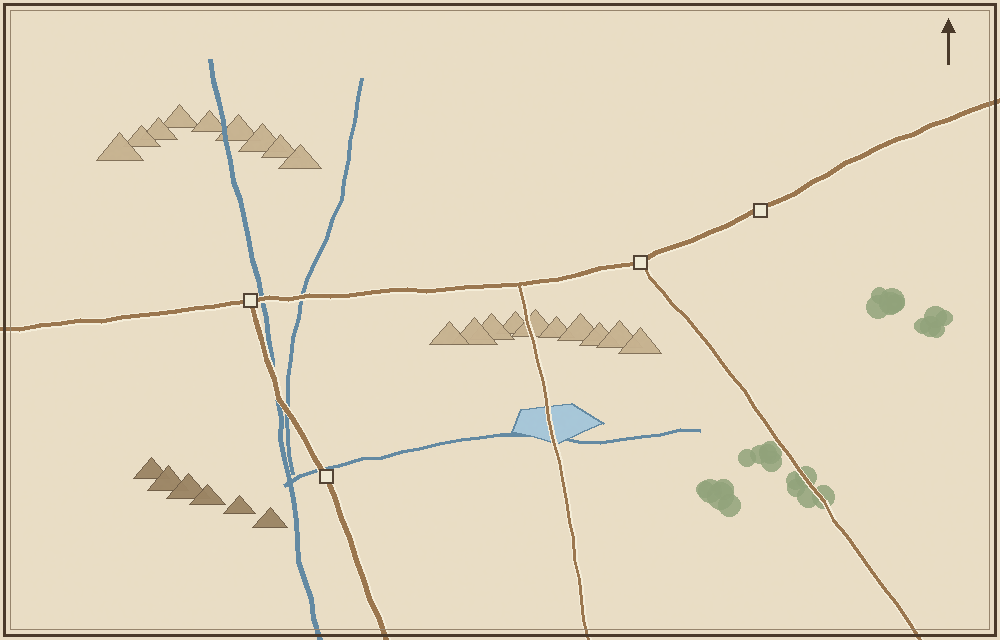 AUSTERLITZ
Brunn
Slavkov town
Wischau
Raigern
Pratzen Hts.
Satschan ponds
to Olmutz
to Vienna
Svratka R.
Litawa R.
AUSTERLITZ
Brunn
Slavkov town
Wischau
Raigern
Pratzen Hts.
Satschan ponds
to Olmutz
to Vienna
Svratka R.
Litawa R.
 Santon
Bosenitz
Puntowitz
Kobelnitz
Sokolnitz
Telnitz
Aujezd
Blasowitz
Pratzen
Krzenowitz
Pratzen Heights
Goldbach brook
frozen ponds
Davout arrives
Olmutz road
Santon
Bosenitz
Puntowitz
Kobelnitz
Sokolnitz
Telnitz
Aujezd
Blasowitz
Pratzen
Krzenowitz
Pratzen Heights
Goldbach brook
frozen ponds
Davout arrives
Olmutz road