Battle of Okehazama
1560 · Japan Short In the demo
Imagawa Army — Oda Army · 9 turns · 49 units
Briefing
"Man's fifty years, set against the realm below the heavens, are but a dream, an illusion." -- the kowaka-mai "Atsumori", danced by Oda Nobunaga on the morning he set out (Shincho Koki)
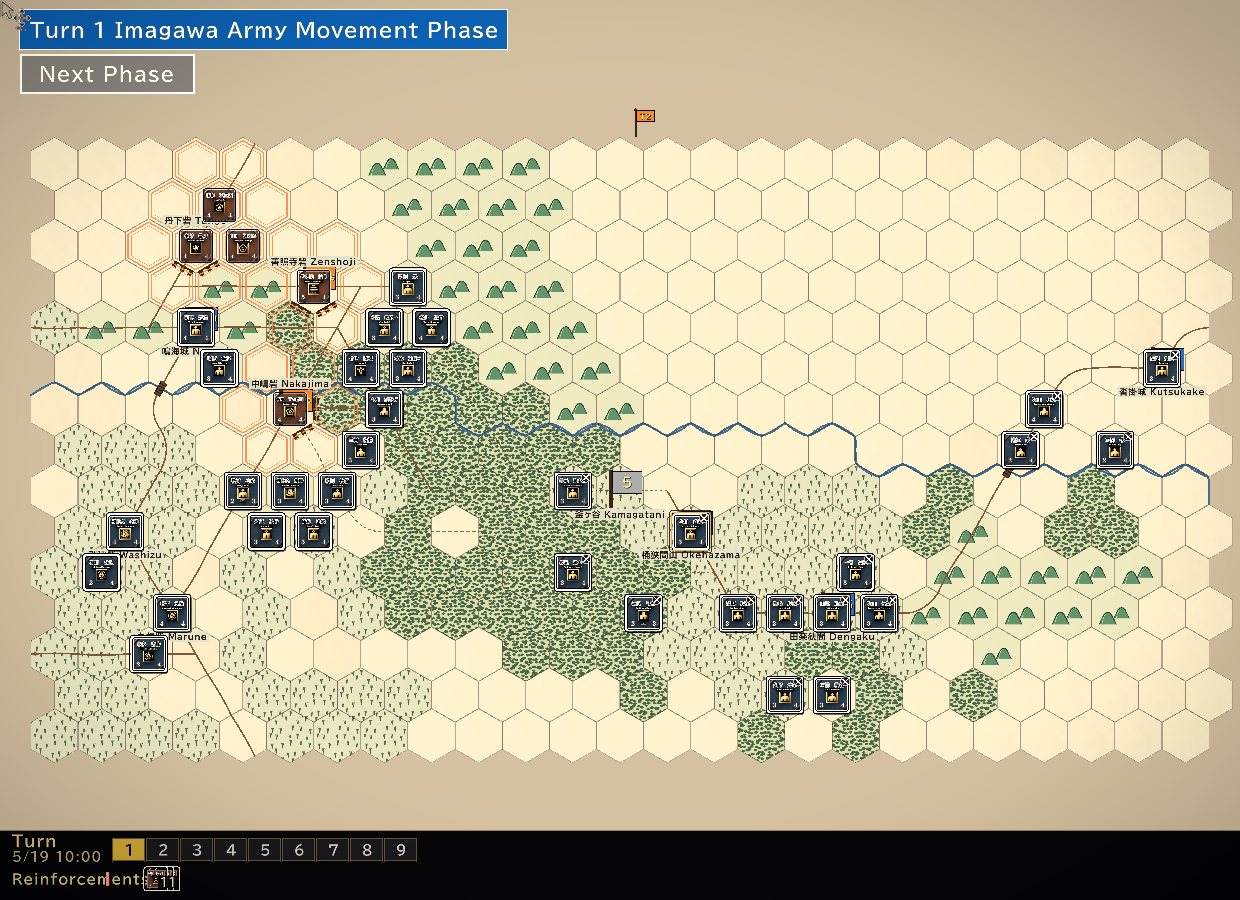
The Imagawa have thirty-three counters on the board; the Oda have sixteen. The Imagawa have more than twice as many. But there is a difference elsewhere too: on the Imagawa side, the only counters that can move of their own accord are the twelve of the vanguard, marching on the Oda forts, and the two in Narumi Castle. The other nineteen are a "standby force" that will not take a single step until its conditions are met: Yoshimoto's headquarters and the followers at Kutsukake sleep until the Oda come alongside them. The Oda can move all sixteen every turn. The answer to this board is probably written in that one line.
The 19th day of the 5th month of Eiroku 3 (12 June 1560), the eastern edge of Owari. Imagawa Yoshimoto was marching west with 25,000 men, and during the morning his vanguard had taken the forts of Marune and Washizu. Yoshimoto himself had hung his curtains among the trees on Mt. Okehazama and was resting his men and horses. That morning Oda Nobunaga left Kiyosu, passed through Atsuta, and went by way of Tange Fort into Zenshoji Fort. The board begins from there. That is why Nobunaga is not on the board at the start. He enters from the centre of the northern edge on T2. The historical Nobunaga came further west, by way of Tange and Zenshoji, but on this board he enters from the north centre; this too is a ruling made for this scenario. His band numbers fewer than 2,000.
[How to win] The result is decided by a single margin. Margin = (points of objectives you hold - points of objectives the enemy holds) + (losses inflicted - losses suffered). On this board the win line is drawn at +20 on the Imagawa side. The Imagawa gain a tactical victory by finishing with a margin of +27 or more (+79 operational, +138 strategic); the Oda gain a tactical victory by driving the margin down to +13 or less (-39 operational, -98 strategic). Anything in between (+14 to +26) is a draw. At the start the margin stands at +40 to the Imagawa. At the start the Oda hold only Zenshoji Fort and Nakajima Fort, worth 10; the rest lies on Mt. Okehazama (20) and Dengaku-hazama (15). When an objective changes hands it counts twice: it is added to the side that takes it and subtracted from the side that loses it. Thus if the Imagawa give up either Mt. Okehazama or Dengaku-hazama, that alone loses them the battle on points. Zenshoji and Nakajima, however, count 15 points when held by the Imagawa (5 while the Oda hold them). Each fort the Imagawa vanguard takes moves the margin by 20.
[One head] The Oda have one path that has nothing to do with the margin. Destroy the "Imagawa Yoshimoto" counter among the trees, and they win at that very moment (sudden death). For the Imagawa, keeping Yoshimoto alive is not enough. Withdraw him and abandon the headquarters, and the head may be saved, but the battle is lost on points.
[Yoshimoto's counter] A little east of the centre of the board, among the trees on Mt. Okehazama, stands "Imagawa Yoshimoto". The moment this counter is destroyed, the Imagawa army loses, whatever the place, the points or the turns remaining. Once Yoshimoto's counter wakes, it can fall back at the same pace as any other unit. The Oda must close his line of retreat before he withdraws, and only then strike. Around him stand two companies of his household guard and his archers, and the camps of Yui Masanobu, Ichinomiya Munekore, Kuno Motomune, Kanbara Ujinori and Miura Yoshinari: commanders who were killed here that day. Matsui Munenobu and Ii Naomori have gone forward with the vanguard and are not here.
[The shape of the board] The Tegoshi and Ogi rivers cross the board from east to west. Attacking across them doubles the defence; the four crossings (bridges) avoid that penalty, and one of them lies between Zenshoji Fort and Nakajima Fort. The deep paddy filling the south-west of the board is the Narumi tidal flat, which in those days reached this far. The low rolling ground from the centre to the south-east is the Arimatsu hills. Mt. Okehazama is woodland, not a prepared position. Dengaku-hazama is a hollow and gives no terrain defence. The three Oda forts, Tange, Zenshoji and Nakajima, have palisades facing south and east. They face the front only, so they are of no use if the enemy comes round the side. Okabe Motonobu in Narumi Castle sits right beside Nobunaga's route. Historically, Nobunaga's retainers seized his horse's bridle to stop him because that road lay in full view of the castle. Narumi Castle is a fortress: units inside it ignore retreat results and are not obliged to attack adjacent enemies. The Imagawa vanguard stands north of the river and west of the Arimatsu hills, too far to return to the headquarters in a single move.
[The western force] Matsudaira Motoyasu, Asahina Yasutomo, Honda Tadakatsu and Ishikawa Kazumasa, resting after taking Marune and Washizu, begin rolling to move from T5 (25%, rising by 25% each turn thereafter). Historically they never moved. If they do, Zenshoji Fort and Nakajima Fort at the Oda's back are in danger.
[Commanders] Imagawa: Imagawa Yoshimoto. Two companies of household guard and the archers. With the vanguard, Matsui Munenobu (lord of Futamata Castle in Totomi) and Ii Naomori (of Iinoya). In the headquarters, Yui Masanobu, Ichinomiya Munekore, Kuno Motomune, Kanbara Ujinori and Miura Yoshinari. Sena Ujitoshi, who had prepared the camp the day before. Okabe Motonobu and the garrison in Narumi Castle. Following along the Kutsukake road, Katsurayama Ujimoto, Iio Noritsura (lord of Hikuma Castle), the Totomi contingent and the Mikawa contingent. To the west, Matsudaira Motoyasu (the later Tokugawa Ieyasu), Asahina Yasutomo, Honda Tadakatsu in his first battle, and Ishikawa Kazumasa. Udono Nagateru in Odaka Castle is off the board.
Oda: Oda Nobunaga and two companies of his horse guards. Hattori Koheita, who put his spear into Yoshimoto, and Mori Shinsuke, who took his head. Maeda Toshiie, who hurried to join though he had been dismissed from service. Sassa Masatsugu and Senshu Suetada, who charged out ahead from Nakajima Fort and were killed. The pages Iwamuro Nagato-no-kami and Hasegawa Kyosuke. The men who joined at Atsuta. In the forts, Sakuma Nobumori at Zenshoji, Kajikawa Heizaemon at Nakajima, and Mizuno Tatewaki, Tsuge Genba-no-kami and Yamaguchi Ebinojo at Tange. Yanada Masatsuna, who reported where Yoshimoto was and was ranked first in merit, is not a counter because no record says he led troops. Sakuma Morishige, killed at Marune, and Oda Hidetoshi and Iio Sadamune, killed at Washizu, had fallen two hours before the board begins.
[What you can test in this half day] Oda: push straight along the road, or go round by the paths along the hills and come out on the flank of the headquarters? Leave the five counters in the forts, or pull them out and add them to the attack (pull them out, and the Imagawa vanguard will come for Zenshoji and Nakajima; each fort lost moves the margin by 20)? Do you have the nerve to ignore Narumi Castle and march past it? The historical Nobunaga did. Imagawa: only the vanguard and Narumi Castle can move; the headquarters and the followers at Kutsukake sleep until the Oda touch them. Send the vanguard against the forts, or turn it back to form a wall before the headquarters? Either way, few turns remain before Nobunaga arrives from the north. The further Yoshimoto withdraws the safer he is, but if the Oda come alongside, he is bound by their ZOC and cannot move, and the ground behind him is the hollow of Dengaku-hazama.
[Outcome] Yoshimoto was killed at Dengaku-hazama. Hattori Koheita put his spear into him, and Mori Shinsuke took his head. The 25,000, having lost only their lord, scattered eastward that same day. The house that had bound together Suruga, Totomi and Mikawa, the foremost warrior house of the Tokaido, came apart over the following ten years. Matsudaira Motoyasu, who had grown up as a hostage in Sunpu, returned to Okazaki Castle, broke with the Imagawa, and in time took the name Tokugawa Ieyasu. Nobunaga gained the eastern door of Owari, and from there set out towards Mino and towards Kyoto. Half a day, a band of fewer than 2,000, and the single point a spear reached. It was in this hollow after the rain that the word "realm" began to carry real weight.
The rain stopped, and the hollow shone.
Twenty-five thousand scattered for a single head.
The boy who had been a hostage went home to the east and changed his name.
The man with fewer than two thousand began to walk west.
Man's fifty years:
those fifty years began with this half day.
The several days of confrontation and the fighting at Marune and Washizu at dawn have been folded away. The board covers only the four and a half hours from Nobunaga's arrival at Zenshoji Fort to the death of Yoshimoto. Of the Imagawa 25,000, only the vanguard of about 10,000 appears on the board; the rest were strung out along the road east of Kutsukake and cannot arrive in time. Strength does not follow head counts: surprise, the downpour and the downhill charge, for which this engine has no mechanism, are added to the Oda combat strength. Some commanders and positions are inferred from contemporary records.
1 hex = 300 m, 1 turn = 30 minutes, 1 CS = about 150 men. T1 = 10:00, T2 = Nobunaga's main body enters, T5 = the western force begins rolling, T9 = 14:00 to 14:30 (end).
Maps
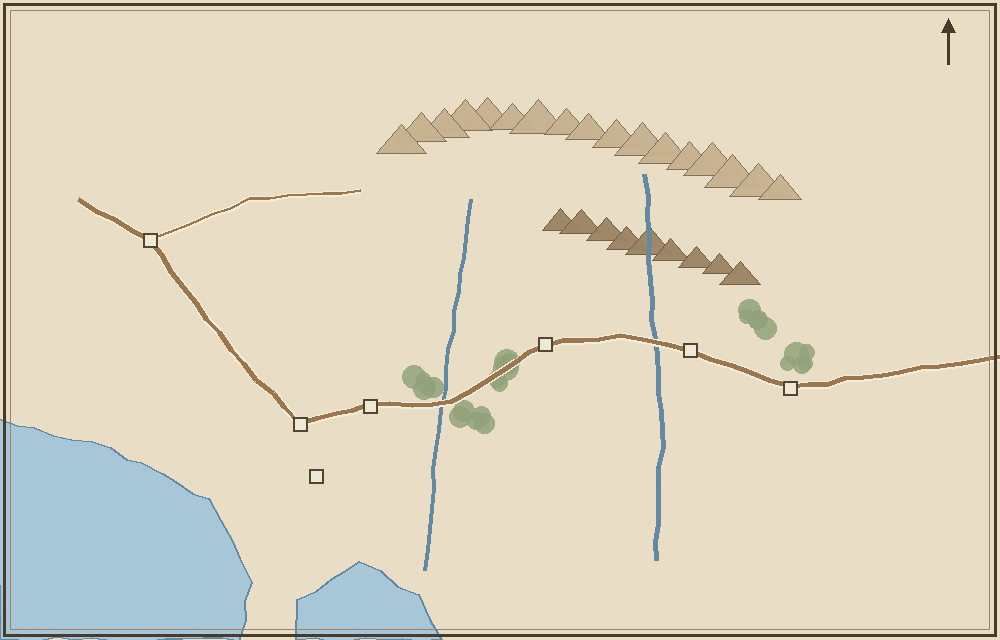 OKEHAZAMA
Kiyosu
Atsuta
Narumi
Odaka
Kutsukake
Okazaki
Yoshida
to Sunpu
Ise Bay
Chita Bay
Sakai R.
Yahagi R.
Mikawa hills
OKEHAZAMA
Kiyosu
Atsuta
Narumi
Odaka
Kutsukake
Okazaki
Yoshida
to Sunpu
Ise Bay
Chita Bay
Sakai R.
Yahagi R.
Mikawa hills
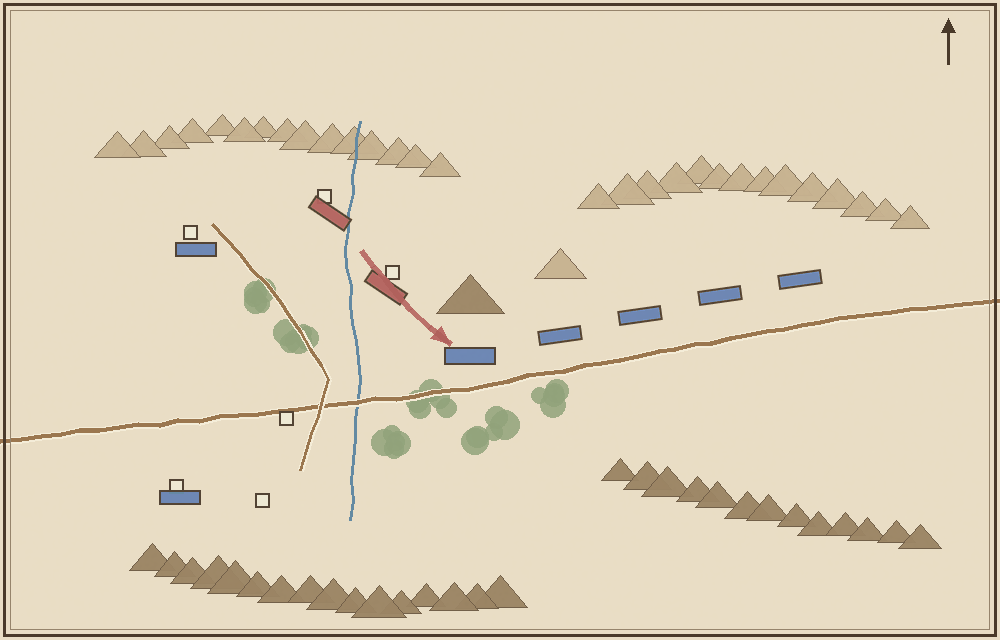 The hollow / Imagawa HQ
Okehazama hill
Narumi castle
Odaka castle
Zenshoji fort
Nakajima fort
Marune fort
Washizu fort
Tokaido road
from Kutsukake
The hollow / Imagawa HQ
Okehazama hill
Narumi castle
Odaka castle
Zenshoji fort
Nakajima fort
Marune fort
Washizu fort
Tokaido road
from Kutsukake