Battle of Waterloo
1815 · Europe Medium In the demo
Anglo-Allied & Prussian Army — Armee du Nord · 11 turns · 78 units
Briefing
Hard pounding this, gentlemen; let us see who will pound longest.
-- said to have been spoken by Wellington to his staff in the thick of the battle (attributed)
Napoleon had 72,000 men that day. What he lacked was not men but the number of orders he could send out at once.
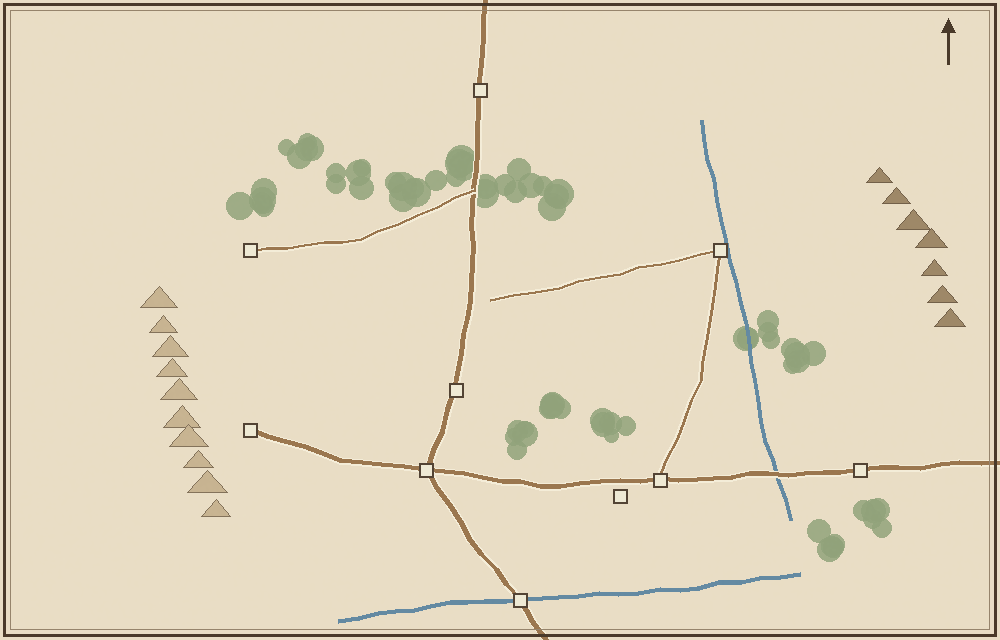
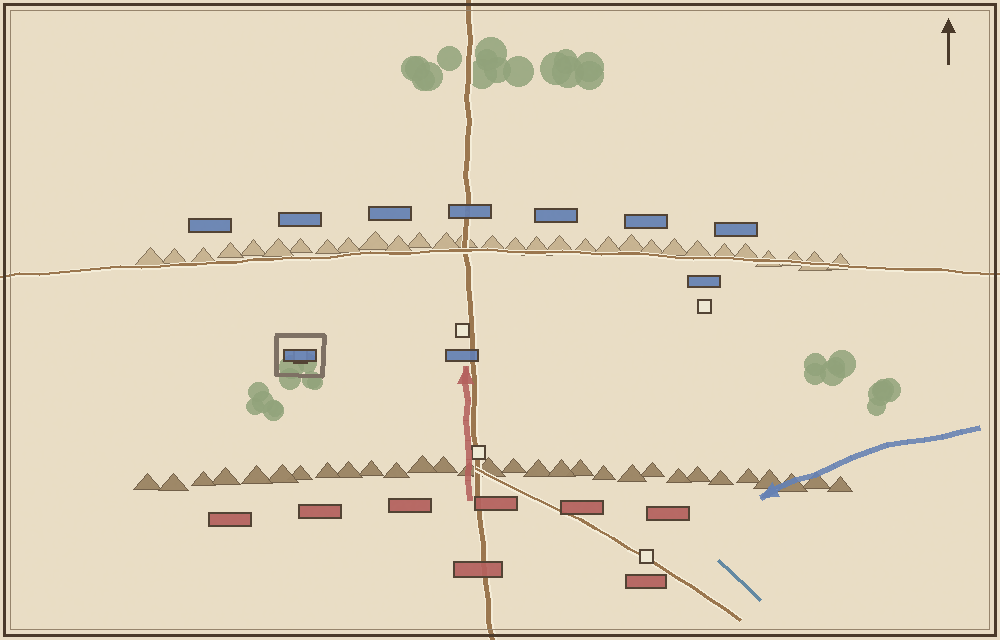
18 June 1815, twenty kilometres south of Brussels. The rain that had fallen since the night before had finally stopped, and the fields of tall rye were everywhere churned to mud. Three days earlier the French army had crossed the frontier. On the 16th Napoleon had beaten Blücher's Prussians at Ligny, while Ney had failed to stop Wellington at Quatre Bras. The Prussians fell back north-east to Wavre, but the French read it as a flight eastward and sent Grouchy after them with 33,000 men. Wellington placed his army on the gentle ridge of Mont-St-Jean and sent word: "If the Prussians come with even a single corps, I will accept battle here." Blücher, seventy-two years old and just recovered from being pinned under his fallen horse, replied that he would come. The French guns began to move at half past eleven, once the ground had dried. Napoleon did not command the front himself. He left it to Ney and spent the afternoon on the heights of Rossomme to the south.
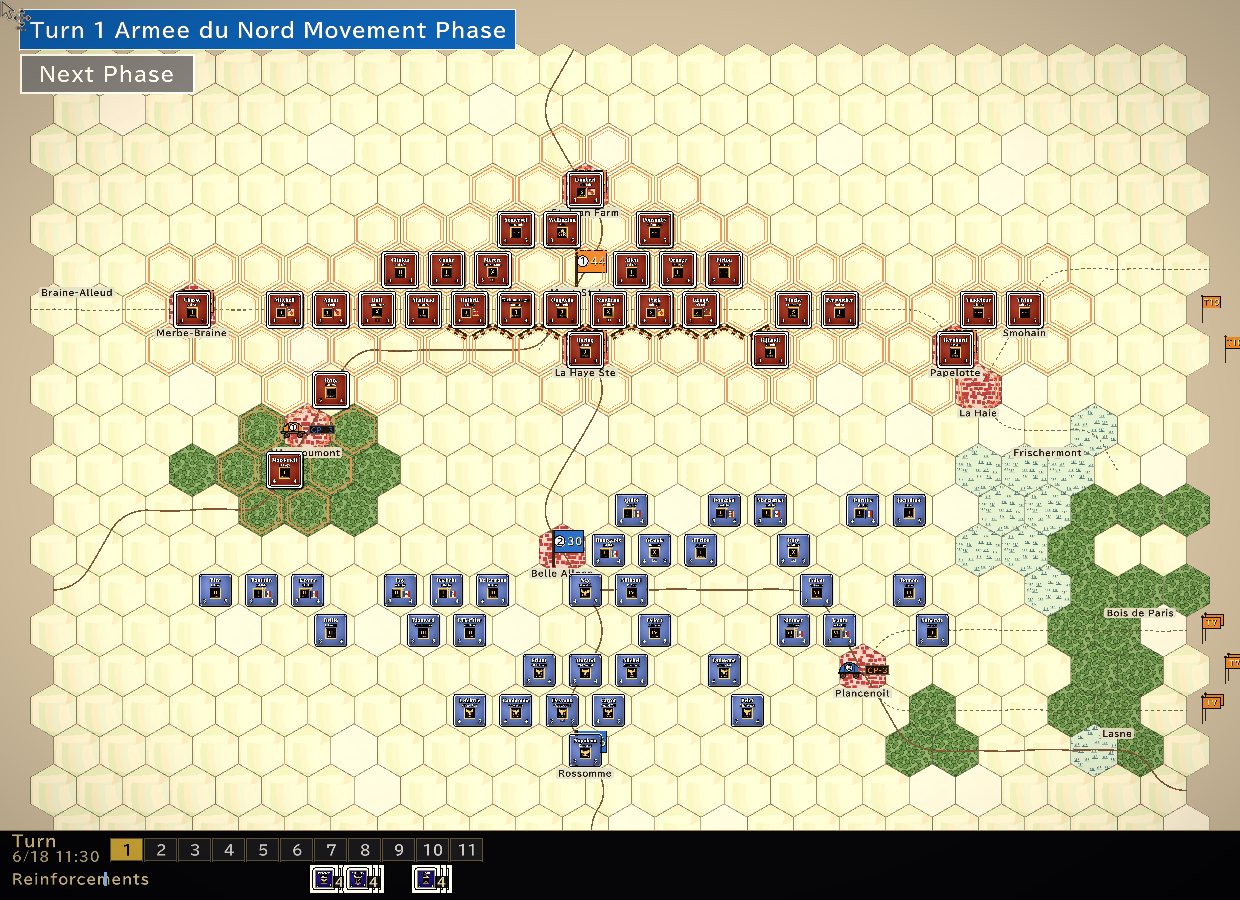
[The crossroads of Mont-St-Jean] Upper centre on the board, the crossroads marked Mont-St-Jean is the heaviest point on this board (44 points), and at the start it is Wellington's. If it is broken through, the only thing behind is the single road to Brussels. The far side of the ridge cannot be seen: Wellington had most of his men lie down on the reverse slope and let the hill swallow the cannonballs.
[How Wellington wins] The board opens at a margin of plus 78, because Wellington holds everything on the ridge (the crossroads 44, La Haye Sainte 28, Merbe-Braine 20, Mont-St-Jean Farm 16, Papelotte 16; France holds only La Belle Alliance 30 and Rossomme 16). [Victory line] It is plus 86. In other words, **holding on is not enough**. Only by giving up nothing on the ridge and also coming out 8 points ahead in the exchange of losses does Wellington win. Put the other way, losing La Haye Sainte alone moves the margin by 56 to plus 22, and if it cannot be retaken, France has won at that point.
[How Napoleon wins] Keep the margin below the victory line until nightfall. But he is short of hands. The French have 36 units, the most on the board. Yet they can move only **12** at a time, the same as the allies. And the French have four places they must deal with at once: Hougoumont in the west, La Haye Sainte in the centre, the ridge itself, and Plancenoit behind them. Only the attacker has to choose where to go. In history too, the front was left to Ney, and orders went out one at a time.
[Hougoumont] In the west of the board, a flag stands on the château of Hougoumont. It carries no victory points at all. While France holds it, the number of counters France can move at once simply rises from 12 to 15. It is a walled stone house, and it is held not by troops inside (it is empty) but by Macdonell in the wood to the south and Byng in the orchard to the north-east. Around the château lie wood, orchard and walled garden, which slow movement (they do not raise the defence). It is because of this enclosure that the two battle lines do not meet head-on in the west. In history it was meant to be a diversion. It became a matter of Jérôme Bonaparte's pride, and most of Reille's corps was drawn into this one farmhouse for the whole day. Both sides can see the bait. They can see it, and still they hesitate every turn.
[Plancenoit] In the south-east of the board, a flag also stands on the village of Plancenoit. This one works the other way. **While the Prussians hold this village, the French limit falls from 12 to 9.** Nothing happens to the allies. It is moves that are lost, not points. In history, Lobau's corps turned to face the Prussians appearing from the east, then the Young Guard was sent in whole, and in the end even two battalions of the Old Guard were spent in the struggle for the village churchyard. Duhesme died there. This one village is the reason there were not enough hands to attack the ridge.
[The sunken road] Along the allied ridge, only to the east of the crossroads, the road runs sunk between banks (shown on the board with the palisade symbol). The ditch lies only on one side, facing south. Only a unit standing here and attacked from the south receives the attack at double combat strength. D'Erlon's 17,000 came up exactly against this front. Note: the deep ravine into which "the cuirassiers fell and were buried", as Victor Hugo later wrote, is this road, but the real hollow is nowhere near so deep.
[The Prussian army] The **black counters** on the board are the Prussian army. They are on the same side as the allies but a separate army, and they are not on the board at the start. Bülow's IV Corps enters from the Lasne defile in the south-east on T7 (16:00), and Zieten's I Corps from Smohain in the north-east on T10 (18:15). They had marched eleven hours through the mud. The marshes in the south-east of the board are that mud.
[Commanders] Allies: Arthur Wellesley, Duke of Wellington. On the right, Hill; Cooke of the Guards Division; Maitland of the 1st Guards Brigade; Byng and Macdonell at Hougoumont. Clinton, Adam of the light brigade, and Mitchell. The Netherlands army: Chassé, Perponcher, and Bylandt, posted on the forward slope. In the centre, Alten; Ompteda of the KGL brigade; Baring, who held La Haye Sainte; Kielmansegge of the Hanoverians; and Halkett. On the left, Picton, Kempt, Pack, Vincke, Lambert in reserve, and Prince Bernhard of Saxe-Weimar at Papelotte. William, Prince of Orange, twenty-two years old that day, held I Corps. The cavalry: Somerset's Household Brigade and Ponsonby's Union Brigade, Vandeleur and Vivian. The artillery: Mercer, Bull and Sandham. The Prussian army (black counters): Blücher, Bülow, Losthin of the 15th Brigade, Hiller of the 16th Brigade, Hacke, Ryssel, and Prince William of Prussia. I Corps: Zieten, Steinmetz, Jagow and Röder.
France: Napoleon. Command of the front, Marshal Ney. II Corps: Reille, Jérôme Bonaparte, Foy, Bachelu, Bauduin (who dies in the wood at Hougoumont), and Piré's cavalry. I Corps: d'Erlon, Quiot, Bourgeois, Donzelot, Marcognet, Durutte, and Jacquinot's cavalry. The grand battery of eighty guns, and Ruty, commander of artillery. VI Corps: Lobau, Simmer, Jeanin, and the cavalry of Domon and Subervie, facing east. The cavalry reserve: Milhaud, Delort, Kellermann, L'Héritier and Blancard. The Guard: Friant, Morand, Michel, Cambronne, Duhesme of the Young Guard, Pelet, who retakes the churchyard, Lefebvre-Desnoëttes and Guyot of the Guard cavalry, and Desvaux of the Guard artillery.
[What to decide in these eight hours] Napoleon: how many units do you put into Hougoumont in the west? Put them in and you gain moves but have fewer troops to attack the ridge. How many do you leave at Plancenoit? Leave them and the front grows thin; leave none and you lose three moves from T7. And the ridge can only be climbed from the front; along the sunken road, the defender counts double. Wellington: you are safe as long as you do not step off the reverse slope, but that will not reach the victory line. The left must hold by itself until the Prussians come, and if you draw Hill's corps on the right towards the centre, the west is left empty.
[Outcome] The gate of Hougoumont was closed. The French who burst into the courtyard were killed to a man, and the château did not fall before nightfall. Wellington later said that "the success of the battle turned upon the closing of the gates at Hougoumont." At half past one, d'Erlon's 17,000 climbed the slope and were stopped by Picton's division. Picton was shot through the head and killed immediately afterwards. The two brigades of British heavy cavalry that went forward next smashed the enemy columns, galloped on as far as the grand battery, and were surrounded by lancers and destroyed. Ponsonby did not come back. At four o'clock Ney sent the cavalry alone against the ridge, without infantry; in two hours they charged more than ten times, and exhausted the cavalry without breaking a single square. At half past four, Prussian guns sounded from the Bois de Paris. Lobau turned about, the Young Guard was sent in, and Plancenoit changed hands again and again. A little after six, La Haye Sainte ran out of ammunition. Baring came out with forty-two men. A hole opened in the centre, and French guns set up there began firing at close range: this was the most dangerous moment. But Napoleon no longer had troops to pour into that hole. They were at Plancenoit. A little after seven, the Guard at last went forward against the front. Maitland's Guards brigade, lying down, rose and fired, and Adam's light infantry wheeled onto its flank. The Guard fell back. The army, seeing it, broke. Zieten came in from the east and linked with the allied left. Blücher and Wellington met before La Belle Alliance, and the Prussians took on the pursuit. Forty-two thousand men fell in a single day. Napoleon abdicated on 22 June, and the Hundred Days were over. Ney was shot in December. Wellington looked at the field and wept, and wrote that "nothing except a battle lost can be half so melancholy as a battle won." And the next day, in Brussels, he put it to Thomas Creevey: "It has been a damned nice thing, the nearest run thing you ever saw in your life."
They waited for the ground to dry; the guns moved at half past eleven.
The gate of Hougoumont was closed, and a whole corps was drawn into it.
Ney charged more than ten times without infantry, and broke not one square.
At half past four, another army's guns sounded from the Bois de Paris.
La Haye Sainte fell. But the men to fill the hole were in a village churchyard.
The Guard fell back: for the first time that day, and the last.
The manoeuvres up to the day before (Quatre Bras, Ligny, the retreat to Wavre) and the pursuit after sunset have been folded away. The board covers only the eight hours from the opening bombardment before noon until the Guard goes forward at seven. Divisions and brigades have been combined into one to three units each. In men, France had 72,000 against 68,000 allies and 50,000 Prussians, but in combat strength on the board France has 134, the allies 108 and the Prussians 42. The national troops of the Netherlands and Hanover have been rated below their numbers, the veteran French divisions and the Guard above, and the Prussians include only "those who had actually reached the field by seven, when the board ends". The 17,000 men posted at Braine-l'Alleud in the west (Colville's division and part of the Dutch army) did not fight once that day and are not on the board.
1 hex = 200 m, 1 turn = 45 minutes, 1 CS = about 600 men. T1 = 6/18 11:30 (the first guns at Hougoumont), T4 = 13:45 (d'Erlon's attack), T7 = 16:00 (Ney's cavalry charges and the arrival of Bülow's corps), T10 = 18:15 (La Haye Sainte falls), T11 = 19:00 (final turn; the charge of the Guard; it ends at 19:45). Both armies can move 12 counters at a time (the allies 15 from T7; France 15 if it takes Hougoumont, 9 if it loses Plancenoit).
Maps
 WATERLOO
Brussels
Genappe
Quatre Bras
Ligny
Sombreffe
Charleroi
Wavre
Namur
Nivelles
Hal
Forest of Soignes
Dyle R.
Sambre R.
WATERLOO
Brussels
Genappe
Quatre Bras
Ligny
Sombreffe
Charleroi
Wavre
Namur
Nivelles
Hal
Forest of Soignes
Dyle R.
Sambre R.
 Mont-St-Jean ridge
Hougoumont
La Haye Sainte
Papelotte
La Belle Alliance
Plancenoit
Forest of Soignes
Ohain lane
Brussels road
Prussians arrive
Mont-St-Jean ridge
Hougoumont
La Haye Sainte
Papelotte
La Belle Alliance
Plancenoit
Forest of Soignes
Ohain lane
Brussels road
Prussians arrive