Battle of Towton
1461 · Europe Medium
Lancastrian Army — Yorkist Army · 11 turns · 66 units
Briefing
"My lord, I have not deserved it, for I slew but fifteen men. I stood still in one place, and they came unto me, but they bode still with me."
-- Sir Andrew Trollope, knighted after the second battle of St Albans while his foot was still lamed by a caltrop (Gregory's Chronicle). A month and a half later he died in the fields of Towton, again standing still in one place.
The Lancastrians have three counters that call themselves bowmen, and every one of them has a range of "1". The Yorkists have six with a range of 2. Only the side with more counters on the board has no hand that reaches far.
This is not a balancing adjustment; it is the wind. 29 March 1461, Palm Sunday. The snow was blowing from the south. Lord Fauconberg, in charge of the Yorkist vanguard, had his archers step out in front of the line, loose a single volley and fall straight back. The arrows rode the following wind over the plateau. The answering arrows were pushed back by the headwind and fell short, at the Yorkists' feet. Fauconberg, it is said, had those arrows gathered and shot back again. This game has no field in which to write the direction of the wind, so only the result can be written: the Lancastrian Bowmen Bowland, Bowmen Richmond and Bowmen Beverley can do nothing but walk into the next hex and strike.
But this advantage does not last. A range-2 unit cannot fire once it is adjacent to an enemy, so the wind drops the moment hand-to-hand fighting begins. So it was in history. The exchange of arrows was over in about half an hour; the Lancastrians, unable to bear it, came forward, and from there it became four hours of pushing. An advantage used up on T1 and T2: that is what the Yorkists bring to this board.
[Six turns: how to hold] Norfolk's men enter from the southern edge of the board on T7 (14:00) and T8 (14:30). Until then the Yorkists have only 26 counters and 92 CS on the board. The Lancastrians have 32 counters and 114 CS. The ratio of combat strength is 1.24 to 1; in men it is thirty thousand against twenty-two thousand, figures that mean the Yorkists will naturally be pushed back. In exchange, the Yorkists have moves. They can move 11 counters at a time: 42% of the 26 on the board, higher than the Lancastrians' 12 of 32 (38%). Pushed back, but not broken: that shape is made by these numbers. When Norfolk's 8 counters and 30 CS arrive on T7, total combat strength turns over to 114 against 122, and the limit rises to 13. This turning over is the battle itself.
[How the Lancastrians win] The board opens at a margin of plus 48, because the four objectives in the north are theirs (Towton 34, North Acres 24, Cock Bridge 18, Castle Hill 14; the Yorkists hold only Saxton 24 and Dintingdale 18). The victory line is plus 70. In other words, holding the opening lead is not enough. Twenty-two more points are needed: take the 20 points of Towton Dale, the hollow between the two armies, and then either the 12 of Bloody Meadow or a matching advantage in units destroyed. Winning the pushing match alone is not a victory.
[How the Yorkists win] Hold for six turns without giving up the hollow, and that alone keeps them inside the line. There is no need to retake anything or to attack north. But occupation means "stopping there", so if no one is standing in the hollow, it becomes Lancastrian. The question is the same as in history: a draw leaves Edward, in London, as king.
[Renshaw Wood] In the east of the board, outside both battle lines, is a wood called Renshaw Wood. It carries no victory points at all. If the Yorkists hold it, the Yorkist limit rises from 11 to 14 (from 13 to 16 from T7); if the Lancastrians hold it, the Yorkist limit falls to 8. The Lancastrian limit does not move by one either way. Still there is a reason to go for it: the road Norfolk comes up by runs beside this wood, and if the Lancastrians hold it, the Yorkists can move only 10 counters even after the reinforcements arrive. The wood is only two or three hexes from either line. It is within reach. But going there thins the line by as much.
[The valley] The Cock Beck, flowing along the west of the board, is drawn as a major river only along the stretch west of Bloody Meadow. There is no way to cross it. Push the Yorkist left against it and there is no line of retreat, but it is the Lancastrian right that has its back to the valley. The river can be crossed at only two places on the board: Cock Bridge in the north-west and a ford in the south.
[Commanders] Lancastrians: in overall command, Henry Beaufort, Duke of Somerset. Henry Holland, Duke of Exeter. Henry Percy, Earl of Northumberland (killed), and his brother Sir Richard Percy (killed). Sir Andrew Trollope (killed): the best tactician in this army since he betrayed the Yorkists at Ludford Bridge. Ralph, Lord Dacre (killed; his tomb is in the church at Saxton, at the south of the board). Lord John Neville (killed): he and the Yorkist Warwick were of cadet branches of the same family, and on this day they stood at the north and the south of the board. Lionel, Lord Welles (killed), Thomas, Lord Roos, Robert, Lord Hungerford, William, Viscount Beaumont, Robert, Lord Willoughby, James Butler, Earl of Wiltshire, and Sir William Plumpton (whose son was killed here). The rest are levies from the north and the Midlands.
Yorkists: Edward IV (nineteen years old; he had proclaimed himself king in London only three weeks before, and staked his legitimacy on this one day). Richard Neville, Earl of Warwick, standing though shot in the leg at Ferrybridge the day before. William Neville, Lord Fauconberg (Warwick's uncle; the business of the arrows was his work). John Mowbray, Duke of Norfolk, and Sir John Howard (wounded). John, Lord Wenlock, John, Lord Scrope of Bolton (wounded here), Sir Walter Blount, William Hastings (knighted on the field after this battle), Sir Robert Horne and Sir Robert Ogle. The veterans of the Calais garrison, brought over the sea by Warwick and Fauconberg, were the only standing army of the island and the best-trained body in this army. The men of Ludlow and Shropshire came from the home towns of the House of York and had been with Edward ever since Mortimer's Cross in February.
Three people are not on the board. John, Lord Clifford, and Lord Fitzwalter had been killed the day before, the 28th: the hollow where Clifford died with an arrow in his throat is Dintingdale in the south-east of the board, and Norfolk's men will tread it the next day on their way up to the battlefield. Thomas Courtenay, Earl of Devon, stayed behind sick in York. And Henry VI, Queen Margaret and Prince Edward wait in the city of York for the outcome throughout these five and a half hours.
[Outcome] After Norfolk's men joined the right, the Lancastrian left was driven in, and the line folded back towards the west. There was only one road north, over Cock Bridge, and those who could not reach it fell into the valley. The name Bloody Meadow was given on this day. The dead of both armies were proclaimed at twenty-eight thousand. Even if that is exaggerated, no single day in England compares with it. Somerset and Exeter fled, and Henry VI's family escaped from York to Scotland. Edward was crowned at Westminster in June. Lord Dacre, it is said, was buried standing upright with his horse in the churchyard at Saxton; five hundred years later, those who dug there would find out whether the story was true. No one wrote down where Trollope's body went.
Blowing from the south, the arrows reached one side only.
Until two, numbers pushed; from two, the road pushed.
There was only one bridge, and those who could not cross are in the valley.
From that day the valley's name changed.
He stood still in one place.
They came unto him, and bode still with him.
Ferrybridge and Dintingdale on the previous day, and the pursuit after sunset, are not on the board. The board covers the five and a half hours from eleven until half past four. For strength, recent middle estimates have been used (Lancaster 30,000 / York 28,000, of whom 6,000 were Norfolk's), not the sixty thousand against forty thousand of contemporary reports. On the board the Lancastrians have a combat strength of 114 and the Yorkists 122, the reverse of the ratio of numbers, because the Calais veterans, the retinues of the marches and the archers with the wind behind them have been added to the Yorkist side. Both armies fought dismounted and sent their horses to the rear, so there is not a single counter on this board with a movement allowance of 5. The story of an ambush in the woods on Castle Hill appears widely in modern reconstructions, but it could not be traced back to the contemporary sources, so it is not placed as a standby force; only the wood and the victory points remain. Note: the levy names and the posts of some counters include inferences from the mobilisation practice of the time.
1 hex = 150 m, 1 turn = 30 minutes, 1 CS = about 250 men. T1 = 3/29 11:00 (the arrows), T7 = 14:00 (Norfolk arrives), T8 = 14:30 (the second part), T11 = 16:00 (end). The Lancastrians can move 12 counters at a time, the Yorkists 11 (13 from T7; +3 if they take Renshaw Wood, -3 if it is taken). The victory line is plus 70 from the first side's (the Lancastrians') point of view, and the opening margin is plus 48.
Maps
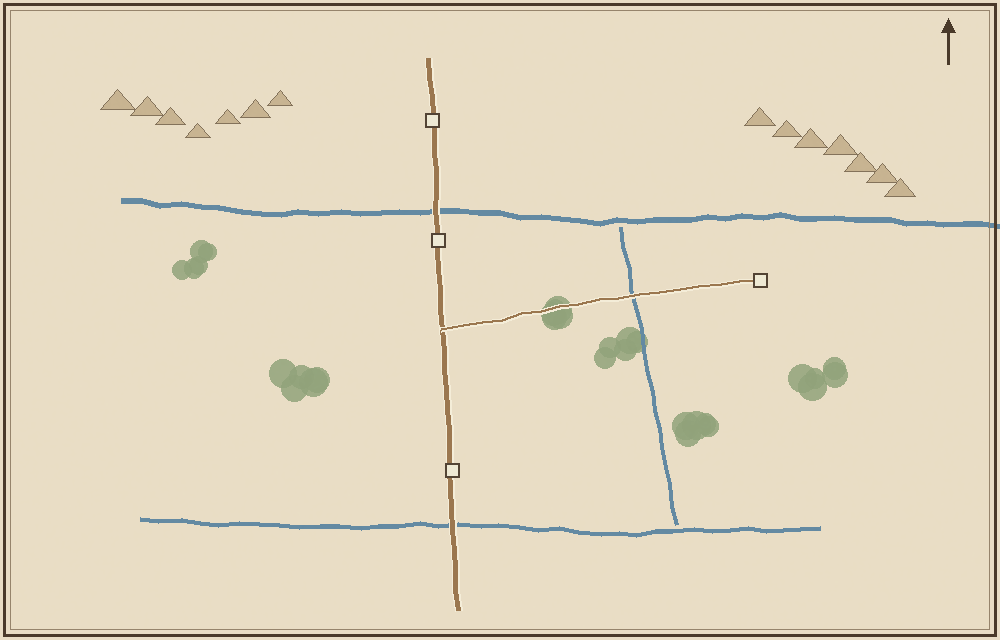 TOWTON
York
Tadcaster
Ferrybridge
Pontefract
Wharfe R.
Aire R.
the London road
TOWTON
York
Tadcaster
Ferrybridge
Pontefract
Wharfe R.
Aire R.
the London road
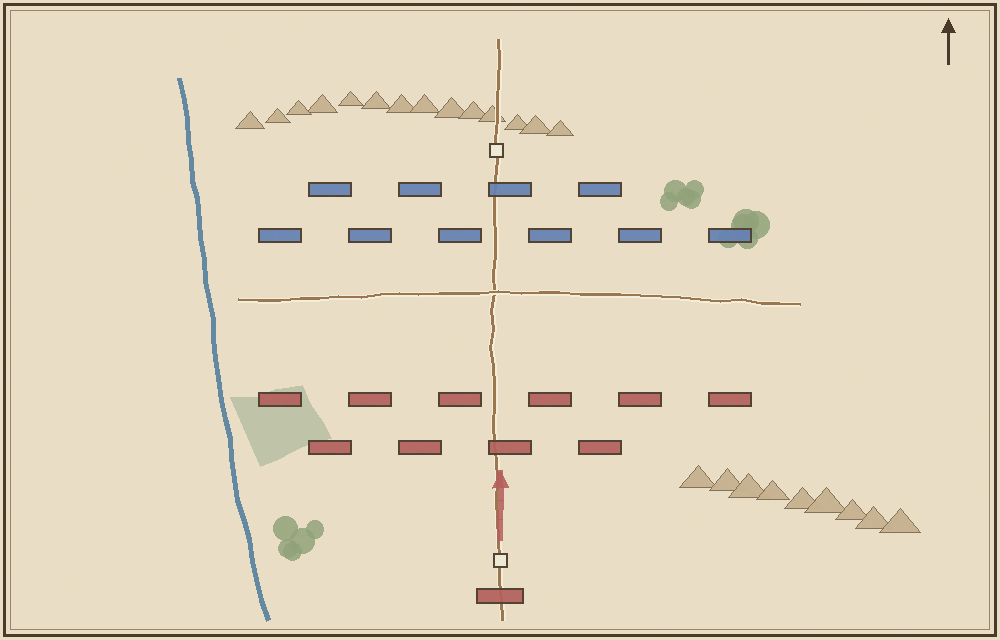 Towton
Saxton / the road
Lancastrians
Yorkists
Cock Beck
Bloody Meadow
the wind blows south
Towton
Saxton / the road
Lancastrians
Yorkists
Cock Beck
Bloody Meadow
the wind blows south