Fourth Battle of Kawanakajima
1561 · Japan Long
Takeda — Uesugi · 14 turns · 82 units
Briefing
"Their whips silent, by night they crossed the river."
— Rai San'yo, poem on a painting of Kenshin's attack (early 19th century), on Kenshin's night crossing of the Chikuma
Kawanakajima, in Shinano. Takeda Shingen has entered Kaizu castle and faces Uesugi Masatora (Kenshin) on Mount Saijo. According to the Koyo Gunkan, Shingen sent a flanking force of twelve thousand under Kosaka Masanobu and Baba Nobuharu to strike Mount Saijo from behind during the night, intending to catch the Uesugi between it and his main body of eight thousand at Hachimanbara when they came down.
Kenshin saw through the plan, came down from the mountain in the night and crossed the Chikuma at the Amenomiya ford. At 6 a.m. on the 10th day of the 9th month of Eiroku 4, the fog lifts to show the whole Uesugi army directly in front of the Takeda main body. The flanking force is on the empty Mount Saijo and has not yet returned.
[How the Takeda win] Twelve units may be activated each turn (the main body at Hachimanbara). The eighteen units of the flanking force enter on Turns 2 to 4 at the south edge of the map, at the western foot of Mount Saijo, and on Turn 9 (10 a.m.) the activation limit rises by six. The Takeda begin holding Hachimanbara (30 points) and Kaizu castle (20); taking the Uesugi positions at the Amenomiya ford (10) and the Tanbajima ford (20) widens the margin. The victory line is -20. If the margin from the Takeda side exceeds -20, they have done better than history.
[How the Uesugi win] Twelve units may be activated each turn. Break the main body at Hachimanbara before the flanking force returns. The rearguard under Amakasu Kagemochi holds the Amenomiya ford against the flanking force, and Naoe Kagetsuna guards the Tanbajima ford to the north, the line of retreat to Zenko-ji.
[Commanders] Takeda: Takeda Shingen; his brother Takeda Nobushige, Yamamoto Kansuke, Morozumi Torasada and Hajikano Tadatsugu, all killed this day; his heir Takeda Yoshinobu, Anayama Nobutada, Naito Masatoyo, Yamagata Masakage, Takeda Nobukado, Hara Toratane, Atobe Katsusuke and Asari Nobutane. Flanking force: Kosaka Masanobu, Baba Nobuharu, Obu Toramasa, Sanada Yukitaka, Aiki Masatomo, Ashida Nobumori, Oyamada Nobushige and Amari Masatada.
Uesugi: Uesugi Masatora (Kenshin); the vanguard under Kakizaki Kageie, Murakami Yoshikiyo, Saito Tomonobu and Honjo Shigenaga; Irobe Katsunaga, Nakajo Fujisuke and Yasuda Nagahide, who received the "blood-stained letters of commendation"; Takanashi Masayori and Suda Mitsuchika, driven out of Shinano; Amakasu Kagemochi with the rearguard; and Naoe Kagetsuna with the baggage.
[Decisions this board poses]
- (Takeda) Hold together at Hachimanbara until the flanking force arrives? Moving forward breaks the trap.
- (Uesugi) Cut straight into the headquarters, or first make sure of the road north to Tanbajima before the flanking force arrives?
- (Uesugi) How long must the rearguard at the Amenomiya ford hold?
[Outcome] The Uesugi threw fresh troops at the Takeda main body one after another, and Nobushige, Kansuke, Morozumi and Hajikano were killed. Later chronicles tell of Kenshin riding alone into Shingen's headquarters and striking at him, the blows taken on Shingen's war fan (a tradition). Around the hour of the snake (10 a.m.) the flanking force, returning from the empty Mount Saijo, crossed the Chikuma behind the Uesugi and broke Amakasu's rearguard. About to be caught between two forces, Kenshin gathered his men, crossed the Sai River and withdrew to Zenko-ji. Both armies suffered heavy losses, and both claimed the victory. The two sides fought at Kawanakajima five times in twelve years, and this day was the fiercest.
When the fog lifted, the enemy stood before them
The camp on the mountain was empty
A brother and a strategist fell guarding the headquarters
Before noon, men came across the river behind
The army of Echigo crossed the Sai and withdrew
Each side said it had won
The dispositions, the strengths (Takeda 20,000, Uesugi 13,000) and the "woodpecker" plan come from the Koyo Gunkan, a military chronicle of the early Edo period. Contemporary sources are few, and Yamamoto Kansuke's role in particular owes much to the chronicle. The single combat of Kenshin and Shingen is left as tradition and is not part of the board.
1 hex = 400 m, 1 turn = 30 minutes, 1 CS = about 450 men. Turn 1 = 6 a.m. on the 10th day of the 9th month; Turn 9 = 10 a.m. (hour of the snake); Turn 14 = 12:30 p.m.
Maps
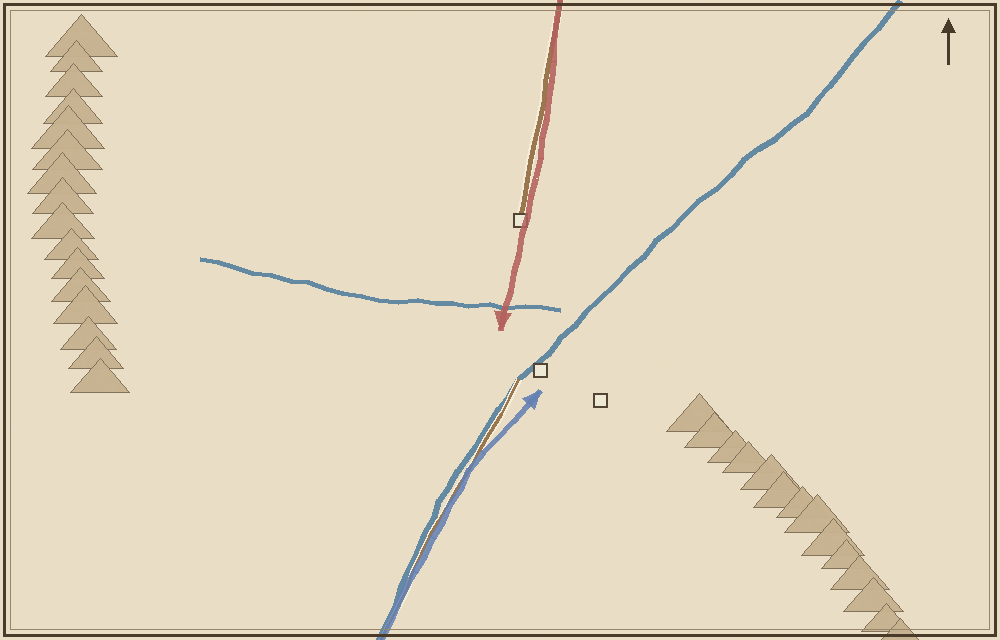 KAWANAKAJIMA
Zenko-ji
Kaizu castle
to Kasugayama castle
to Kofu
Kai (Takeda)
Echigo (Uesugi)
Chikuma River
Sai River
KAWANAKAJIMA
Zenko-ji
Kaizu castle
to Kasugayama castle
to Kofu
Kai (Takeda)
Echigo (Uesugi)
Chikuma River
Sai River
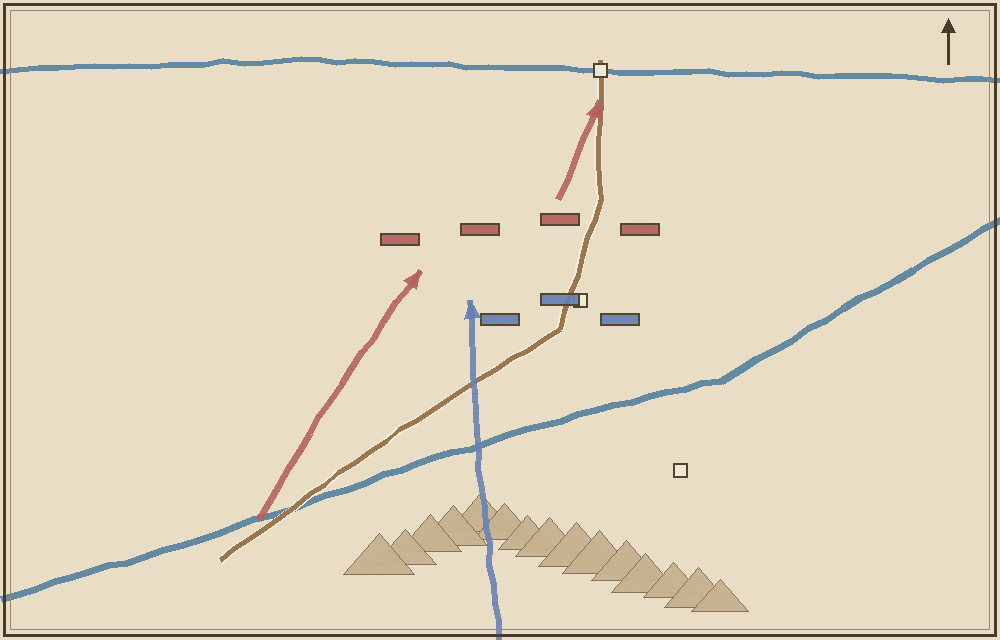 Hachimanbara (Takeda main body)
Mt. Saijo (Uesugi camp, empty by dawn)
Kaizu castle
Amenomiya ford (Uesugi crossing, Amakasu rearguard)
Takeda flanking force (12,000)
Whole Uesugi army
Tanbajima ford (Uesugi line of retreat)
Chikuma River
Sai River
Hachimanbara (Takeda main body)
Mt. Saijo (Uesugi camp, empty by dawn)
Kaizu castle
Amenomiya ford (Uesugi crossing, Amakasu rearguard)
Takeda flanking force (12,000)
Whole Uesugi army
Tanbajima ford (Uesugi line of retreat)
Chikuma River
Sai River